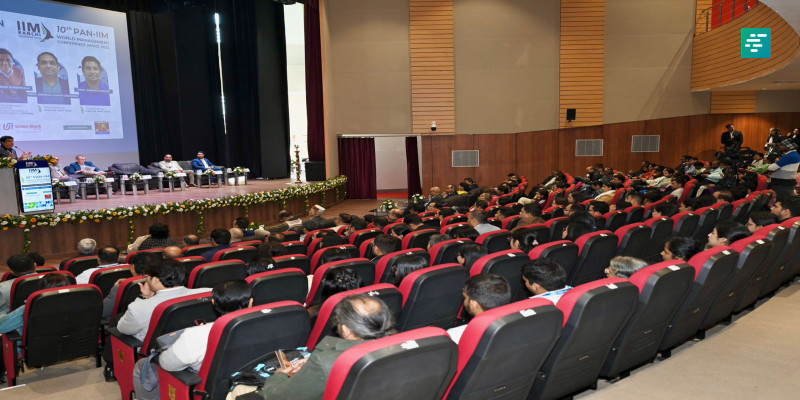
IIM Ranchi Inaugurates the 10th Pan-IIM World Management Conference 2025
- Campus Updates
- 28 Nov, 2025
- 556
The 10th Pan-IIM World Management Conference (WMC) 2025 commenced on November 27th, 2025 at the IIM Ranchi, bringing together leading academicians, industry experts, policymakers, and practitioners to deliberate on the theme “Driving Social Impact through Management Research.” The inaugural day of conference witnessed thought-provoking sessions, transformative dialogues, and a collective commitment toward shaping a socially impactful management ecosystem for the future.
Conference Chairperson, Prof. Manish Bansal, opened the conference by welcoming all dignitaries and delegates. Emphasizing the crucial role of management research, he stated that research-driven insights are essential for social transformation and addressing urgent global challenges. He also highlighted that the conference theme aims to strengthen research–practice linkages and foster impactful collaborations spanning the next three years. Conference Chairperson, Prof. Subhro Sarkar, highlighted the three-day lineup of sessions, noting that the meaningful discussions offered a fresh narrative on social impact - one that inspires others to adapt, innovate, and deepen their engagement with research.
Conference Patron & Director, IIM Ranchi, Prof. Deepak Kumar Srivastava, congratulated all participants and reiterated the Institute’s commitment to meaningful research. He noted that IIM Ranchi produces 1,300–1,400 research papers annually, supported by a strong doctoral community of around 72–80 scholars. Two years ago, the Institute initiated a conscious shift toward research in social and sustainable development domains, turning challenges into opportunities for innovation through collective academic effort.
Guest of the inaugural session, Entrepreneur, Investor, Philanthropist, and Co-Founder of upGrad, Shri Ronnie Screwvala, delivered a powerful keynote message. He stated that IIMs are institutions that build global citizens, and that innovation and excellence form the foundation of leadership. Linking his insights to India’s vision of Viksit Bharat 2047, he encouraged scholars and faculty to:
-
Ask deeper questions, as “zero-announcement solutions” emerge from inquiry.
-
Trust authentic peer review to refine meaningful research.
-
Pursue innovation without hesitation and embrace new ideas fearlessly.
-
Prioritize impact over profit-philanthropy, value systems, and scale of thought are key to nation-building.
He urged India’s academic community to think originally rather than replicate external models, emphasising that true impact is born from visionary thinking and a holistic approach.
Distinguished Guest of inaugural session Shri Paul Procee, Country Director, World Bank, highlighted the importance of completing tasks with the same seriousness as solving challenges. Observing current market needs, he stressed that:
-
Small-scale projects need structured financing, and innovative minds can create viable solutions.
-
Private sector potential grows significantly when supported by enabling government frameworks.
-
Technological and AI advancements must be internalized meaningfully.
He emphasized four essential pillars for the coming years: Learn - Adapt - Develop - Skill, urging India’s youth to focus on capacity building to collectively fulfill the vision of a developed nation.
In his concluding remarks for the inaugural session, Conference Chairperson, Prof. Krishna Kumar Dadsena, congratulated all selected participants for their research contributions. He highlighted that the conference received over 1,400 research paper submissions from across India and several international destinations, including the USA, South Korea, and countries in Europe. Out of these, 1,000 papers have been selected, representing diverse fields of management and interdisciplinary studies. Notably, 20% of the selected submissions come from practitioners and policymakers, reinforcing the conference’s mission of bridging academic theory with real-world application and impact.
The first day of the conference featured a series of insightful panel discussions and keynote sessions. In the opening panel, Prof. Deepak Kumar Srivastava, Director, IIM Ranchi, brought together six Directors from premier IIMs to explore how these institutions can lead India’s development agenda. The distinguished panel included Prof. Ashok Banerjee (Director, IIM Udaipur), Prof. Pawan Kumar Singh (Director, IIM Tiruchirappalli), Prof. Prafulla Agnihotri (Director, IIM Sirmaur), Prof. Nalini (Director-in-Charge, IIM Shillong), Prof. Neeraj Dwivedi (Director, IIM Kashipur), and Prof. Samir Kumar Srivastava (Director, IIM Amritsar). Together, they emphasized strengthening research practices that can meaningfully influence national policy and industry. Prof. Ashok Banerjee highlighted the importance of translational research by sharing how faculty at IIM Udaipur work directly with companies to solve real-world problems. Prof. Neeraj Dwivedi further stressed the need to nurture entrepreneurship across IIMs by equipping entrepreneurs with research-driven insights to help them identify genuine industry challenges and develop practical, high-impact solutions.
In the Keynote Address, Shri Geoff Perry, Executive Vice President and Managing Director (Asia Pacific), AACSB International, spoke on “Leveraging AI for Social Impact.” He explained how AI enables scaled, data-driven solutions to societal issues by enhancing accessibility, precision, and reach, while also empowering institutions to accelerate social innovation through predictive analysis and informed decision-making.
Prof. Subhro Sarkar, moderated a panel discussion focused on the theme “Influence for Impact.” The session featured insights from Shri Gunjan Sharma (Assistant Editor, Press Trust of India), Shri Amit Gupta (Founder, The Reppro), and Prof. Rohit (Faculty, IIM Ranchi). The speakers emphasized the crucial role of responsible information dissemination and discussed how incorrect messaging or misguided branding can adversely influence public perception. They highlighted the importance of integrity, accuracy, and thoughtful communication in ensuring that information creates a positive and constructive impact on society.
Prof. Manish Bansal, moderated panel discussion on “Research Methods,” where experts such as Prof. Arvind Sahay, Prof. Sari Mattila, and Prof. Ajeet Mathur shared their perspectives on innovative research approaches. They emphasized that robust research methods enable deeper inquiry, broaden understanding, and open new dimensions for academic learning and exploration.
In the series of panel discussions, Prof. Krishna Kumar Dadsena moderated an engaging session on the theme “Internationalisation for Impact.” The discussion featured distinguished speakers - Prof. M.J. Xavier (CEO, DFT Group of Institutions and Former Director, IIM Ranchi), Prof. Pallavi Srivastava (Professor, Jaipuria Institute of Management), and Prof. Swarup Kumar Dutta (Faculty, IIM Ranchi) - who shared their perspectives on creating management education that is globally oriented yet deeply connected to local realities. They highlighted the significance of fostering cross-border learning, developing culturally grounded research collaborations, and pursuing international partnerships that contribute to strengthening local communities. The panel collectively emphasized that while global engagement is essential, it must be aligned with national priorities to ensure meaningful and sustainable societal impact.
The first day concluded with vibrant participation across discussions, paper presentations, and knowledge-sharing platforms. The cultural programme in the evening, followed by the Director’s Welcome Dinner, further enriched the experience by fostering meaningful networking among delegates. The conference will continue on November 28th, 2025, with engaging sessions on public sector enterprises, international accreditation, MSME development, case pedagogy, entrepreneurship, and the Indian business system.
