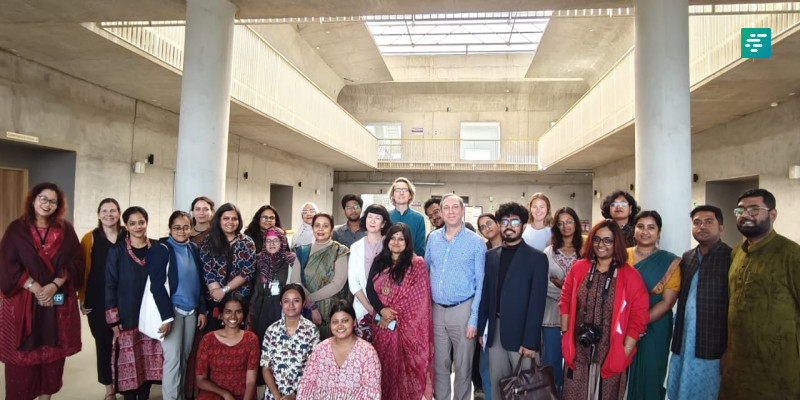
The Indian Institute of Technology Hyderabad (IITH) has further strengthened its global academic footprint by hosting the UKRI International Symposium on Nineteenth-Century Studies, titled “Transnational Encounters in/through South Asia”, on January 8–9 and January 29, 2026. Organised by the Public Humanities Initiative (PHI Centre), IIT Hyderabad, under the leadership of Dr. Shuhita Bhattacharjee, in collaboration with Kingston University, UK, the symposium marked the first event of its kind in South Asia.
The symposium emerged from a major UK Research and Innovation (UKRI) grant focused on expanding collaborative research on nineteenth-century Indo-British history, with IIT Hyderabad serving as the lead India partner. Scholars from across India, the United Kingdom, and the United States convened to explore colonial encounters, gendered histories, visual archives, and cultural exchanges that shaped South Asia during the long nineteenth century.
The event featured keynote addresses by eminent scholars---Dr. Tara Puri (Senior Lecturer, University of Bristol), who examined colonial photographic archives of Indian women, and Prof. Supriya Chaudhuri (Professor Emerita, Jadavpur University), who analysed evolving representations of affect in nineteenth-century verbal and visual texts by and about women. The symposium also included significant contributions from scholars such as Radhika Govinda (University of Edinburgh), Ross Forman (University of Warwick), Fariha Shaikh (University of Birmingham), Alexander Bubb (University of Roehampton), Jessica Durgan (University of Bemidji, USA), Priti Joshi (University of Puget Sound), and Priya Raman (University of Exeter).
Across two intensive days, discussions ranged from colonial exhibitions and performance cultures to gendered and embodied encounters, while also drawing strong connections between nineteenth-century studies and contemporary global challenges, including Climate Change, Public health inequities, and Sexual violence legislation. The symposium underscored how historical inquiry continues to inform present-day social and political concerns.
A major outcome of the symposium was the launch of the Nineteenth-Century Diversities Research Network (NCDRN)—the first South Asian network dedicated to nineteenth-century studies—by Dr. Shuhita Bhattacharjee, in collaboration with Dr. Eadaoin Agnew (Kingston University), who heads the UK-based Victorian Diversities Research Network. This initiative positions IIT Hyderabad at the centre of an emerging global research consortium on nineteenth-century studies and public humanities.
International scholars lauded the initiative. Dr. Radhika Govinda (University of Edinburgh) described the symposium as “a gathering of unprecedented range that generated rich interdisciplinary conversations across diverse global contexts.” Dr. Tara Puri (University of Bristol) highlighted the “urgent necessity and remarkable achievement of creating a shared platform that meaningfully connects scholars across the Global South and North.”
Welcoming the initiative, Dr. Aalok Khandekar, Head, Department of Liberal Arts, IIT Hyderabad, noted that the launch of the South Asian network exemplifies “the public-spirited, interdisciplinary scholarship that the Department seeks to nurture.” Dr. Shuhita Bhattacharjee, Founder-Coordinator of the Public Humanities Initiative (PHI Centre), expressed gratitude for the institutional support and reaffirmed IIT Hyderabad’s growing role as “a significant international hub for nineteenth-century studies and collaborative public humanities research, especially through the establishment of the new global network.”
Prof. B S Murty, Director, IITH, congratulated the efforts in the successful conduct of the symposium, and urged the researchers in the field to bring out the rich Indian cultural heritage and history through their studies.
The symposium strengthened IIT Hyderabad’s expanding engagement with humanities and global scholarship, highlighting how a leading technology institute can actively support and enrich humanities-based interdisciplinary research and international academic collaboration.
