Indian Institute of Management Jammu Hosts Vittamanthan 2026: A High-Impact Post-Budget Dialogue on India’s Economic Future
- Campus Updates
- 15 Feb, 2026
- 296
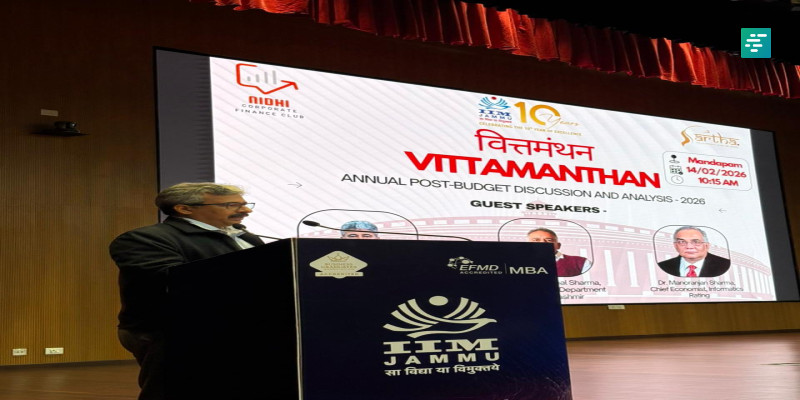
The Indian Institute of Management Jammu convened its flagship annual post-budget conclave, Vittamanthan 2026, at Mandapam, bringing together policymakers, economists, academicians, and students for an in-depth analysis of the Union Budget 2026. The forum served as a vibrant platform to deliberate on India’s fiscal priorities, structural reforms, and long-term economic trajectory aligned with the vision of Viksit Bharat 2047.
The event was graced by distinguished Chief Guests of Honour Dr. Arun Manhas, Director of Industries and Commerce, Jammu & Kashmir; Shri Madan Gopal Sharma, Director, Finance Department, Jammu & Kashmir; and Dr. Manorajan Sharma, Chief Economist, Informatics Rating. The occasion was also attended by Dr. Praveen Kumar, Dr. Jai Kamal, and Dr. Garima Maurya, faculty members of IIM Jammu, along with a large gathering of faculty, officers, staffff, students and scholars.
Addressing the role of technology in governance and economic transformation, Dr. Arun Manhas Director of Industries and Commerce, Jammu & Kashmir, highlighted the government’s strategic emphasis on digital public infrastructure, artificial intelligence, and platforms such as Digi Locker and UPI, underscoring India’s global leadership in digital payments adoption. He described Artificial Intelligence as a transformative disruptor of the job market and emphasized the urgent need for skill development, AI literacy, and responsible AI governance. He further spoke about initiatives such as Mission Karma yogi, collaborations with IIM Jammu, integration with J&K Bank, and incentives for green and sustainable innovation, while stressing India’s emerging role as a trusted AI partner for the Global South.
Shri Madan Gopal Sharma, Director, Finance Department, Jammu & Kashmir underscored the importance of the Economic Survey as a critical lens to interpret the Union Budget and reiterated the national aspiration of achieving Viksit Bharat 2047 through sustained annual growth of 7 percent and above. He elaborated on the sectoral composition of GDP, noting the dominance of services followed by industry and agriculture. Highlighting the budget’s thrust areas, he spoke on infrastructure expansion, rare earth development, high-speed rail connectivity, tourism-led employment generation, semiconductors, pharmaceuticals, and healthcare workforce expansion. While characterizing the budget as balanced and growth-oriented, he also pointed out the need to enhance allocations for education and health in comparison with global benchmarks, alongside prudent management of fiscal deficit and public debt.
Offering a macroeconomic perspective, Dr. Manorajan Sharma, Chief Economist, Informatics Rating. emphasized India’s growing contribution to global growth and advocated for growth with stability and financial inclusion. He highlighted encouraging indicators such as the declining fiscal deficit, strong performance in defence manufacturing, renewable energy progress nearing global benchmarks, asset monetization in roads and railways, and improved profitability of scheduled commercial banks. He termed GST a transformative reform in India’s tax architecture while cautioning against emerging global risks including interest rate volatility, data privacy challenges, and cybersecurity concerns in the expanding digital public infrastructure ecosystem.
The session witnessed active engagement from students and faculty, fostering rigorous and informed dialogue on policy design, economic resilience, and governance reforms. Vittamanthan 2026 once again demonstrated IIM Jammu’s role as a thought leader and catalyst for meaningful discourse on national economic priorities, reaffirming its commitment to nurturing analytically grounded, policy-aware, and future-ready leaders for a rapidly evolving India.
